South Carolina’s Best in Show

Patty Wentworth has won more than 300 ribbons from the South Carolina State Fair for her cooking and crafts.

Wentworth’s won 300-plus ribbons for cooking, crafts

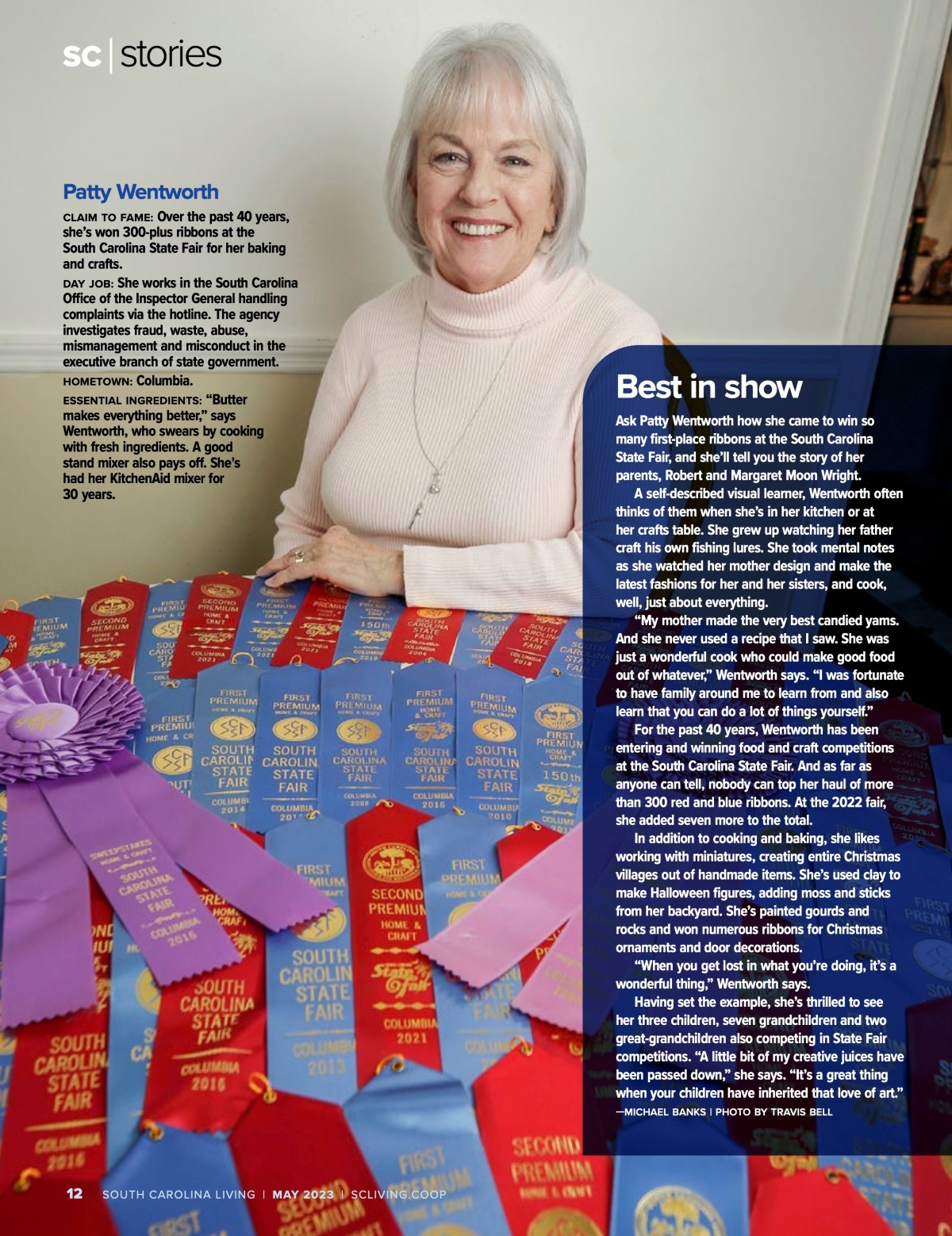
Patty Wentworth is shown in her Columbia, S.C., home alongside her prized mixer and other cooking tools that have helped her win more than 300 blue and red ribbons from the South Carolina State Fair over the past 40 years. Photo by Travis Bell.

A self-described visual learner, Patty Wentworth often thinks of the others that came before her when sheโ€™s in her kitchen or at her crafts table.

Sheโ€™d watch as her father, Robert, would craft his own fishing lures and replace a faulty carburetor. Sheโ€™d mentally takes notes as her mother, Margaret Moon Wright, mended a ripped seam or stood at the stove, her biscuits baking.

โ€œMy mother made the very best candied yams. And she never used a recipe that I saw. She was just a wonderful cook who could make good food out of whatever,โ€ Wentworth says. โ€œI was fortunate to have those people around me to learn from and also learn that you can do a lot of things yourself.โ€

Wentworth is one of the top prize winners in South Carolina State Fair history as her handiwork — whether it be her biscuits or a miniature camping scene captured in an old pork and beans can — has captured more than 300 blue and red ribbons over the past 40 years.

Wentworth often starts with a recipe but isnโ€™t afraid to go off-script. For example, a prize-winning candy entry started off as cake.

โ€œIt was a terrible mess,โ€ she says. โ€œThe cake was just goo. I thought, โ€˜Oh my goodness, this is not good.โ€™ So, I turned it into candy, rolling it into round balls and then pecans. And it ended up winning the Sweepstakes. That was just a stroke of luck.โ€

She likes working with miniatures, creating entire Christmas villages out of handmade items. Sheโ€™s used clay to make Halloween figures, adding moss and sticks from her backyard. Sheโ€™s painted gourds and rocks and won numerous ribbons for Christmas ornaments and door decorations.

โ€œWhen you get lost in what youโ€™re doing, itโ€™s a wonderful thing,โ€ Wentworth says.

She has three children, seven grandchildren and two great-grandchildren. In the past, her daughter won a blue ribbon for her biscuits and one granddaughter won a blue ribbon in photography at this yearโ€™s fair.

โ€œA little bit of my creativity has been passed down and thatโ€™s a wonderful thing to see,โ€ says Wentworth, who won seven ribbons at the 2022 State Fair. โ€œItโ€™s a great thing when your children have inherited your love of art.โ€


Getting to know Patty Wentworth

Claim to fame:ย Over the past 40 years, sheโ€™s won 300-plus ribbons at the South Carolina State Fair for her baking and crafts. The multitude of ribbons are kept in a drawer in her kitchen.

Day job:ย She works in the South Carolina Office of the Inspector General handling complaints via the hotline. The agency investigates fraud, waste, abuse, mismanagement and misconduct in the executive branch of state government.

Hometown:ย Columbia, S.C.

Kitchen essentials?: โ€œButter makes everything better,โ€ says Wentworth, who swears by Crisco and buying quality, fresh ingredients. A good stand mixer also pays off as sheโ€™s had her Kitchen Aid mixer for 30 years.


Editorโ€™s Note:ย Aย version of this SC Stories profileย was featured in the May 2023 issue ofย South Carolina Living,ย a magazine that is distributed 11 times a year to more than 1 million South Carolinians by The Electric Cooperatives of South Carolina.

History’s music man

Zach Lemhouse is not only a talented musician, but he’s also a teacher of history, who’s bringing alive stories of SC’s past through music.

Lemhouse uses his violin to help tell South Carolina’s past

Zach Lemhouse often plays his violin for visitors to Historic Brattonsville, an 800-acre living history site in McConnells, S.C. Photo by Nathan Bingle.

When Zach Lemhouse weaves his bow across the taut strings of his violin, itโ€™s more than just the notes of a by-gone era that fills the space. Within the rhythm is the music, history and a love of learning thatโ€™s formed the composition of his life.

When Lemhouse plays for visitors at Historic Brattonsville, an 800-acre living history site in McConnells, S.C., heโ€™s hoping his passion for history and music translates in the songs you would have heard in the Carolina Piedmont in the 18th and 19th centuries.

โ€œItโ€™s hard to know where youโ€™re going if you donโ€™t know where youโ€™ve been,โ€ says Lemhouse, who is the staff historian for four museums in York County (S.C.).

The son of two teachers in the Clover (S.C.) public school district, family vacations were always at historic sites across the state. That fostered the interest in our past and he would follow in his fatherโ€™s footsteps, teaching history to middle school students for five years soon after his graduation from Winthrop University. 

Musically, the 31-year-old Lemhouse started taking violin lessons when he was 7 after seeing a fiddle player in an โ€œold-time bandโ€ perform traditional gospel tunes at a Sunday camp meeting at his church. 

โ€œI saw it and fell in love with it,โ€says Lemhouse, who learned by playing classical and, about 20 years ago, he included old-time tradition, as well as Scottish and Irish folk songs that heโ€™ll play at Brattonsville alongside his mentor, Nash Lyle. He embraces the traditional music and teaches those skills at the Jink and Diddle School of Scottish Fiddle held each year in the North Carolina mountains.

โ€œIโ€™m an educator,โ€ he says. โ€œI may not be in the classroom any more, but Iโ€™m a teacher. To effectively transfer knowledge from one person to another. Thatโ€™s what I did in the classroom and, absolutely, thatโ€™s what Iโ€™m doing at Brattonsville.โ€


Getting to know Zach Lemhouse

AGE: 31. He was born June 26, 1990.

CLAIM TO FAME: Heโ€™s the staff historian for the Culture and Heritage Museums of York County (S.C.) and director of the Southern Revolutionary War Institute, a research library dedicated to the study of the oft-forgotten Southern campaigns of the American Revolution.

HOMETOWN: York, S.C.

IS IT A FIDDLE OR VIOLIN?: The funny answer? โ€œA violin has strings; a fiddle has strangs,โ€ Lemhouse says. โ€œOr a fiddle has a red neck.โ€ Seriously? โ€œThereโ€™s no difference.โ€

WHATโ€™S ON HIS BOOKSHELF?: Stuck between the studies on the American Revolution, theories of educational thinkers and scores of sheet music, youโ€™ll find several comic books. โ€œIโ€™m more of a DC fan than a Marvel fan. Especially Batman.โ€

Where to hear his music:

In addition to his work at Historic Brattonsville, Lemhouse is also a member of three Bluegrass bands โ€“ the legendary WBT Briarhoppers, established in 1934 and inducted into the North Carolina Music Hall of Fame in 2020, the Whippoorwill String Band and the Cottonwood Bluegrass Band — where his set list expands to include favorites like the โ€œOrange Blossom Specialโ€ and โ€œRagtime Annie.โ€

Zach Lemhouse plays “Ashokan Farewell” on a custom Lehmhaus cigar box fiddle.

As staff historian for the Culture & Heritage Museums, Lemhouse’s interviews with top bluegrass and Americana bands will be featured in this year’s Southern Sound Radio concerts, live performances recorded at the McCelvey Center in York and broadcast every Saturday in November from 8 to 10 p.m. on all S.C. Public Radio stations.

The 2022 lineup includes performances by Della Mae (Nov. 5), Chatham County Line (Nov. 12), Ruthie Foster (Nov. 19) and Steep Canyon Rangers (Nov. 26). In the interviews, band members reflect on the evolving nature of traditional music and discuss historical crossovers of genres that encompass the roots music of the Carolina Piedmont. 

Find your South Carolina Public Radio station and livestream details at southcarolinapublicradio.org. The full interviews are also available on the Culture & Heritage Museum’s YouTube page


Editorโ€™s Note: version of this SC Stories profile was featured in the November/December 2022 issue of South Carolina Living, a magazine that is distributed 11 times a year to more than 1 million South Carolinians by The Electric Cooperatives of South Carolina.

Preacher man preachin’

Everybody talkinโ€™. Preacher man preachinโ€™.
Let’s talk ekphrasis, a written response to a work of art, and my take on Romare Bearden’s “Carolina Shout.”

Words by Michael Banks in response to artist Romare Bearden’s collage titled “Carolina Shout.”

Everybody talkinโ€™. Preacher man preachinโ€™.

Everybody's hands out. Ainโ€™t nobody givin'.

Falling in the water. Red moon a risinโ€™.

Bringing back a dead man. Ainโ€™t that their mission?

Gotta get right. Gotta get salvation.

Ainโ€™t nobody know my sticky situation.

Feet in the mud. Brotherhood of Nation.

Everybody hands up. Meet my creation.

Tuesday mornings, I try to set aside an hour to jumpstart that creative part of my brain. I find it getting harder and harder to do so as the years creep by. But one thing I’ve discovered that helps immensely is Pen to Paper Live.

These weekly one-hour sessions conducted by the founders and staff of the Charlotte Lit organization are held over Zoom. Often more than 20 creators gather and write after receiving a “prompt” by the instructor. Some of my published works have gotten their start at Pen to Paper and I’m always inspired and comforted by the talented writers who gather there weekly.

The words I’ve written above come from the Tuesday, Oct. 4, 2022, session led by Kathie Collins, one of the founders of Charlotte Lit. The prompt was ekphrasis, which Kathie described as “a written response to a work of art.” I’ve tried a bit of ekphrastic writing before, mainly with Van Gogh’s “Wheatfield of Crows,” and it surprises me the words that come to me from another’s work of art.

On Tuesday, as an example, Kathie pointed to writer Sharan Strange’s poem titled “Train Whistle” that’s taken from artist Romare Bearden’s collage “Mecklenburg County, Daybreak Express.”

Born in Charlotte, NC, in 1911, Romare Bearden, by the time of his death in 1988, had achieved a stature known by few artists during their lifetimes. He is considered Americaโ€™s greatest collagist and his works are in the permanent collections of most every major American museum.

This entire month, Charlotte Lit is celebrating Bearden and his legacy. Through a series of events titled “Artists Reckoning With Home: Celebrating Romare Bearden,” the arts organization hopes these events provide opportunities to learn about Charlotteโ€™s past and re-imagine its future.

One of the featured events will be an ekphrastic workshop titled “Writing With Bearden.” The workshop, led by Charlotte Lit co-founders Kathie Collins and Paul Reali, will be held Sunday, Oct. 16 from 2 to 3 p.m. at the Mint Museum Uptown. The event is free, but registration is required.

‘Someone saved my life tonight’ at an Elton John concert

Elton John’s songs, “Someone Saved My Life Tonight” and “Daniel” hold special meaning for two.

When you work guest relations at a stadium that hosts more than 70,000 people in a setting, you’re going to get the full gamut of personalities: the good, the bad, the ugly.

Sunday night, before Sir Elton John took the stage at Bank of America Stadium in Charlotte, I met two beautiful people who shared the story of one very special gift.

Steve Hilfiker and Vannessa Blais had come to the concert together and I greeted them as they entered the stadium atop my usual Section 123. They shared with me their mutual bond: that being the heart that beat in Steve’s chest.

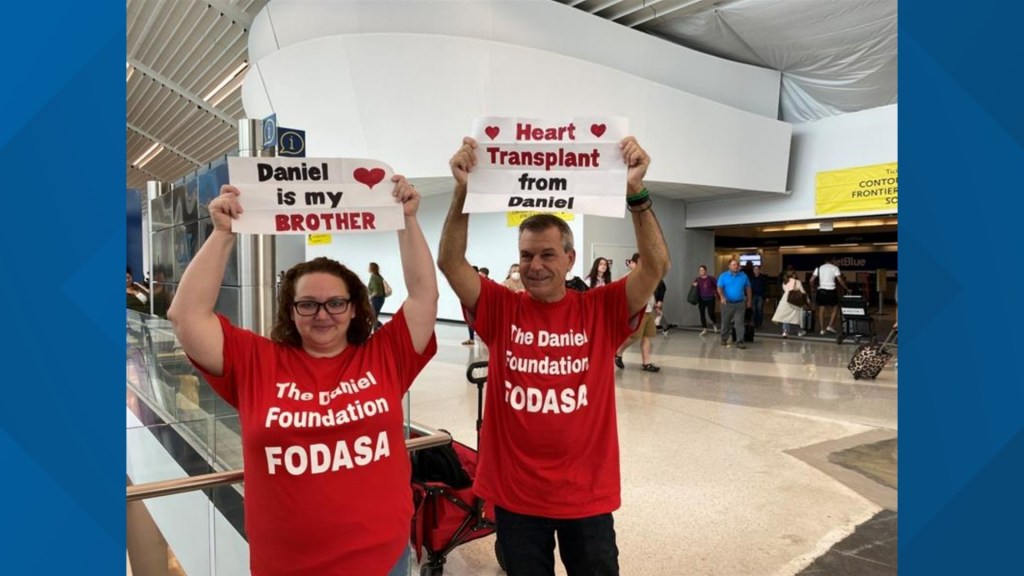
Steve Hilfiker and Vannessa Blais are shown at Charlotte Douglass International Airport on Sunday, Sept. 18, 2022, ahead of Elton John’s concert in Charlotte.
(Photo from Charlotte TV station WCNC website)

Steve, who lives in Fort Myers, Fla., is a transplant survivor and the heart that’s kept him alive these past few years is that of Vannessa’s brother, Daniel, a North Carolina man who passed away in 2020. The matching shirts that they wore to Sunday’s concert read: The Daniel Foundation.

Steve has made it his mission to raise awareness about cardiac sarcoidosis, the disease that very nearly took his life, and promote more effective methods for early detection and treatment of CS. His story is shared in the short documentary, “Stoneheart: An Undying Gift,” screened at this year’s Cannes International Film Festival.

Both Steve and Vannessa said it’s important to tell of the importance of organ donation and share the message of hope.

Steve mentioned the words in Elton John’s hit song, aptly titled “Daniel,” that holds a special meaning to him.

""Do you still feel the pain, of the scars that won't heal? Your eyes have died, but you see more than I. Daniel, you're a star in the face of the sky."

Around Steve’s neck hung a stethoscope. He said that when Sir Elton would sing “Someone Saved My Life Tonight,” Vannessa would place the stethoscope to Steve’s chest and listen to the sound of her brother’s heart, still beating, still there, still present.

And later Sunday night, under a dark, starless sky, I listened to Elton’s voice and thought of Vannessa and the stethoscope pressed against Steve’s chest, and I marveled at the good we can do, the generous we can be, and the moments we miss if we just don’t stop and listen.

Someone saved my life tonight.

Elton John performs near the end of his concert Sunday, Sept. 18, 2022, at Bank of America Stadium in Charlotte, NC. The show marked John’s 36th and final performance in North Carolina. He first performed in Charlotte in November 1972 and eventually performed 14 times in the Queen City. (Photo by Michael Banks)

Healer of bodies, minds and souls

John Glenn Creel is a family doctor that runs his own practice, Walterboro Adult & Pediatric Medicine, and is chief of the Edisto Natchez-Kusso Tribe of SC and pastor of his own church, Little Rock Holiness Church.
โ€œI try to use my time wisely. When Iโ€™m sitting, I just canโ€™t sit.”

Chief of SC’s Edisto Natchez-Kusso Tribe also serves as family doctor and pastor

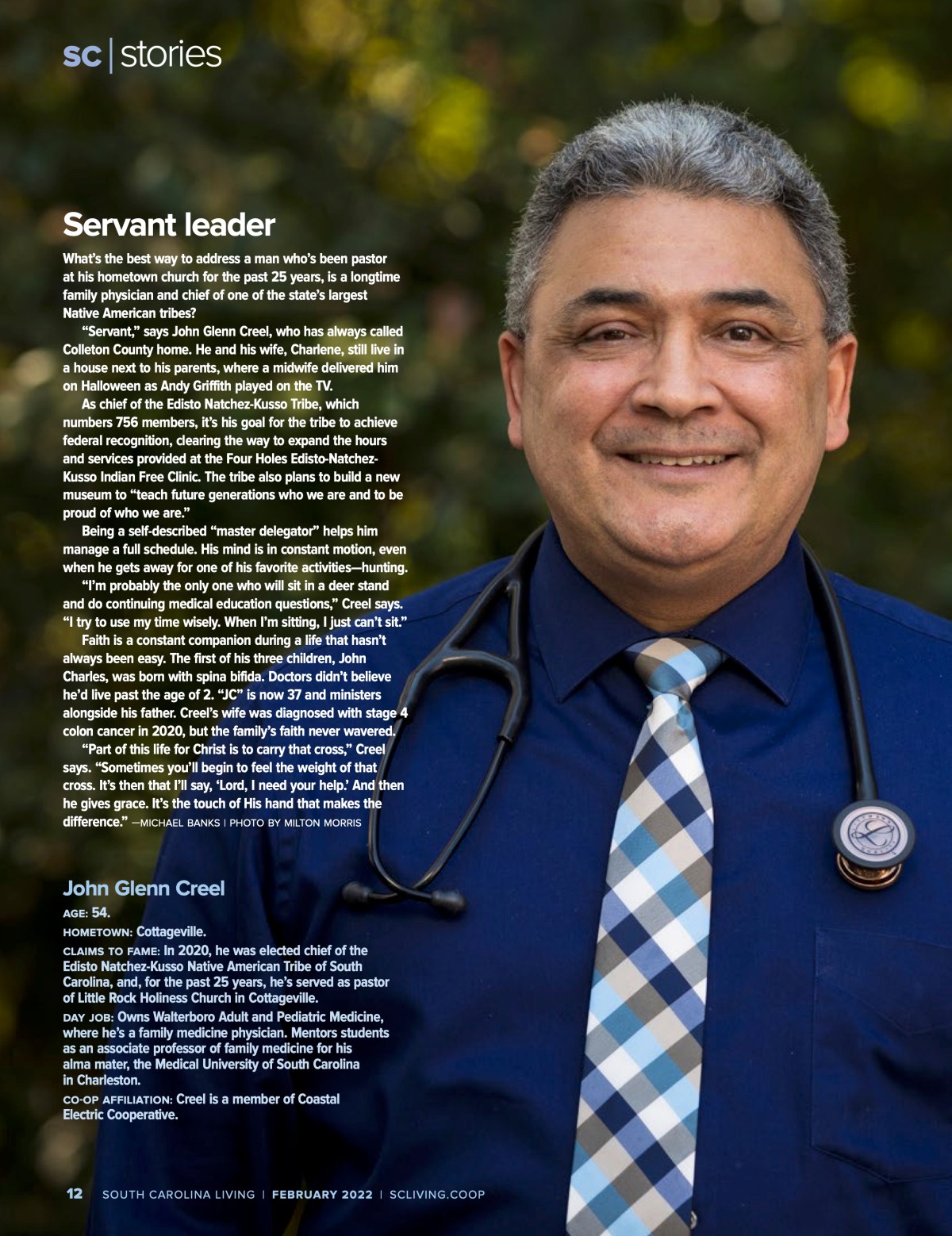
John Glenn Creel is the owner of Walterboro Adult and Pediatric Medicine, where heโ€™s a family medicine physician. He’s also chief of the Edisto Natchez-Kusso Tribe, which numbers 756 members, and pastor of Little Rock Holiness Church in Cottageville, S.C. Photo by Milton Morris.

Whatโ€™s the best way to address a man whose been pastor at his hometown church for the past 25 years, is a longtime family physician and chief of one of the stateโ€™s largest Native American tribes?   

         โ€œServant,โ€ says John Glenn Creel, who has always called Colleton County home. He and his wife, Charlene, still live in a house next to his parents, where a midwife delivered him on Halloween as โ€œAndy Griffithโ€ played on the TV.

         As a child, he struggled in math and reading and he even repeated the fourth grade. His goal of becoming a doctor seemed unattainable.

         โ€œI just thought it wouldnโ€™t be possible being a minority and a minority in a very rural community,โ€ he says. โ€œWe had limited income, limited resources. Weโ€™re Native Americans, but weโ€™re not federally recognized. That was a big obstacle.โ€

ย ย ย ย ย ย ย ย ย As chief of the Edisto Natchez-Kusso Tribe, which numbers 756 members, itโ€™s his goal to achieve that federal recognition, clearing the way to access for federal grants. That money can be used to expand the hours and services provided at the non-profit Four Holes Edisto-Natchez-Kusso Indian Free Clinic he operates, as well as build a new museum and help teach โ€œfuture generations who we are and to be proud of who we are.โ€

         Thatโ€™s important, says the father of three.

         โ€œIโ€™ve done the best to try and balance things and keep the focus on the family. Thatโ€™s how it was with my parents. We were always together. Familyโ€™s important. So is being in a small community. Itโ€™s not the just the family and parents that raise the child, itโ€™s the village or the community. And our communities have always been close-knit.โ€

         Being a self-described โ€œmaster delegatorโ€ helps him manage a full schedule. His mind is in constant motion, even when he gets away for one of his favorite activities — hunting.

         โ€œIโ€™m probably the only one that will sit in a deer stand and do continuing medical education questions,โ€ Creel says. โ€œI try to use my time wisely. When Iโ€™m sitting, I just canโ€™t sit. I can prepare sermons when I sit in the stand.โ€

         Faith is a constant companion during a life that hasnโ€™t always been easy. The first of their three children, John Charles, was born with spina bifida. Doctors didnโ€™t believe heโ€™d live past the age of 2. โ€œJCโ€ is now 37 and ministers alongside his father. Charlene was diagnosed with stage four colon cancer in 2020.

ย ย ย ย ย ย ย ย ย โ€œPart of this life for Christ is to carry that cross,โ€ Creel says. โ€œI donโ€™t mind carrying the cross, because itโ€™s wonderful. Sometimes youโ€™ll begin to feel the weight of that cross. Itโ€™s then that Iโ€™ll say, โ€˜Lord, I need your help.โ€™ And then He gives grace. Itโ€™s the touch of his hand that makes the difference.โ€


Getting to know Glenn Creel

John Glenn Creel

Age:ย 54 (birthdate 10-30-1967)

Hometown:ย Cottageville, S.C.

Claim to fame: In 2020, he was elected chief of the Edisto Natchez-Kusso Native American Tribe of South Carolina and, for the past 25 years, heโ€™s served as pastor of Little Rock Holiness Church in Cottageville.

Day job: Heโ€™s owner of Walterboro Adult and Pediatric Medicine, where heโ€™s a family medicine physician and mentors students as an associate professor of family medicine for his alma mater, the Medical University of South Carolina in Charleston.

Co-Op Affiliation:ย Creel is a member of the Coastal Electric Co-Op in Walterboro, S.C.


Editorโ€™s Note:ย Aย version of this SC Stories profileย was featured in the October 2021 issue ofย South Carolina Living,ย a magazine that is distributed 11 times a year to more than 1 million South Carolinians by The Electric Cooperatives of South Carolina.

The blank page and Lin-Manuel Miranda

Lin-Manuel Miranda writes like he’s running out of time and I’m staring at a blank page.

Thereโ€™s a blank page before me and, damn it, if I donโ€™t blame Lin-Manuel Miranda.

         โ€œItโ€™s like the drip, drip, drip thatโ€™ll never stop.โ€

         โ€œEncanto.โ€ โ€œHamilton.โ€ Something to take your mind off the writing, she said. I watch and I hear the words of Lin-Manuel and I stew and the next morn comes and the day is still gray.

         โ€œRise up.โ€

         My mind doesnโ€™t stop now. Itโ€™s an endless loop of Lin-Manuel and his rhythm.

         โ€œRise up.โ€

         Again, Lin-Manuel, get out of my head.

         โ€œRise up.โ€

         The blank page awaits. I try morning, then noon, then night. But the words still donโ€™t come.

         โ€œOh, no. We donโ€™t talk about Bruno.โ€

         Rhyme after rhyme fills my head. But my words do not come. Not the words that Lin-Manuel Miranda writes. So creative. So talented. So damn good.

         Yet, all I have is the blank page and Lin-Manuel in my head.

         โ€œIโ€™m willing to wait for it. Wait for it. Wait for it. Wait for it. Wait for it.โ€

Lin-Manuel Miranda is shown in Columbia in 2018 in this photo taken from his Twitter page @Lin_Manuel. Miranda is an American actor, singer-songwriter, playwright, and film director. He is known for creating the Broadway musicals ‘In the Heights’ and ‘Hamilton,’ and the soundtrack of Disney’s ‘Encanto.’

NOTE: The above work came from a writing prompt presented during a recent Pen to Paper Live session hosted by the Charlotte Lit organization. You can register here. In the session, presenter Kathie Collins offered a writing prompt taken from a recent workshop led by poet Jessica Jacobs. We were challenged to try some layered writing in which we’d use some metaphors, physical objects, paintings, etc. to connect an experience we were feeling.

Here where the rain falls

Twelve messy thoughts create one lovely idea.

The rain falls here down near where the South Fork and Catawba meet.

            The branches of the tea olive outside my window hang heavy with water, lime green offshoots reach up, seeking sunlight, but instead itโ€™s a cloud-filled sky. Tiny yellow clusters of bloom emit the sweet scent, but my window stays closed and I fear more rain.

            I think of my great aunt Catherine, she gone nearly 15 years now, and how sheโ€™d tug my ear and say, โ€œMichael B. Youโ€™re gonna do great things.โ€

            But this morning, my mind remains muddied of the dream that lingers from the night before โ€“ me going from room to room, opening doors, only to find four blank walls and empty spaces. The only sound being that of the click of the latch and slam of the door. A constant opening and closing. Click, slam. Click, slam. 

            I sip the cold water from the glass and wait for the coolness to make its way down my throat and spread across my chest. I hope it brings energy. A spark to beat back my malaise. The bed, the warm covers, they beckon.

            Gloom, gloom, gloom.

            The Rolling Stones sing of โ€œWild Horsesโ€ and how โ€œfaith has been broken, tears must be cried, letโ€™s do some living, after we die.โ€

            Iโ€™ve done some living and never really thought of others. Things I should have said, but didnโ€™t. Thought my silence an easy salve, not realizing the pain left behind.

            It is still Tuesday morn here and the rain still falls.

            Each day another red X on the calendar and another day closer to when breath will come no more.

            Until then, these words will be written and songs will be sung. Her smile and laugh and love as constant as the reappearing sun.

NOTE: The above work came from a writing prompt presented during a recent Pen to Paper Live session hosted by the Charlotte Lit organization. You can register here. In the session, presenter Kathie Collins offered a writing prompt taken from a recent workshop led by poet Ada Limon.

The Messy Now

Prompt created by Ada Limรณn

1.         Describe where you are.

2.         Add something you see.

3.         Mention a friend and something that friend says.

4.         Include a dream.

5.         Add something from the natural world.

6.         Say something you need.

7.         Repeat a word or a line three times.

8.         Add a line of a song you love.

9.         Apologize for something.

10.       Give the date or the day.

11.       Tell us something youโ€™re scared of.

12.       Tell us something you love.

An early morning in Vegas

Some of the sights and sounds of a fantasy football draft.

ย ย ย ย ย ย ย ย ย ย ย ย 

Itโ€™s an early Saturday in Vegas, the sun climbing above the Valley of Fire only a few hours earlier, and a pack of Pakistanis behind me are chittering like hyenas surrounding a fresh kill.

            โ€œAdreeeen Peterson, Aaaadddreeen Peterson, Ayyydreeeen Peterson,โ€ they chant, clapping and hopping from one foot to another, their target one of their own โ€“ he apparently shell-shocked, face dazed, finger still hovering over his laptop.

ย ย ย ย ย ย ย ย ย ย ย ย Moments earlier, heโ€™d kicked off their fantasy football draft by making the first overall selection. Only problem was that heโ€™d selected the wrong Adrian Peterson. Instead of drafting fantasy stud Adrian Peterson, the future Hall of Famer and bellcow for fantasy championship squads, our Pakistani had instead selected the Chicago Bearsโ€™ Adrian Peterson, he ofย few yards and even fewer championships.

            And still they clap and chant. โ€œAyyydreeen Peterson, Ayyydreeen Peterson, Aydreen Peterson.โ€

ย ย ย ย ย ย ย ย ย ย ย ย The wayward Pakistani sinks his head to his table, accepting his fate and knowing his season is over before it starts

            I turn back to my table and stare across at H-Diddy. Heโ€™s wearing his Bears jersey, arms folded across his chest, and heโ€™s alternating between taking puffs of a Monte Cristal heโ€™s kept stashed away from his wife over the past nine months, while popping green, yellow and orange M&Ms 

            โ€œThings happen,โ€ Diddy says, his facial features temporarily clouded in puff of Cristal. The smoke rises and he smiles. โ€œVegas, baby.โ€

Sharing the story

Read of one woman’s push to chart a path for those wishing to discover their heritage in South Carolina.

As a child, Dawn Dawson-House learned plenty about this countryโ€™s founding fathers. Missing were the exploits of South Carolina civil rights leader the Rev. Joseph Delaine and Robert Smalls, a former slave who represented the Palmetto State for five terms in Congress.ย 

Those lessons were learned at the family dinner table as well as at church and other social gatherings around her hometown along the coast.

โ€œThe community of Beaufort wonโ€™t let you forget that African-American history is important,โ€ Dawson-House said. โ€œOur teachers, our families, our festivals and events, you were surrounded by African-American heritage. I found it interesting because it spoke to us.โ€

Since January 2021, Dawson-House has been the executive director of the WeGOJA Foundation. Pronounced we-GO-juh, the name is a fusion of three languages spoken by people of African descent who were brought to America as slaves.

WeGOJA works to document and promote African-American heritage sites in South Carolina. That work is done through historical markers, listings on the National Register of Historic Places and the Green Book of South Carolina. Teacher guides are provided for classrooms and there are plans to provide toolkits for the large number of African-American families who gather here each year for reunions.

Dawson-House, who spent nearly 25 years in public relations for the SC Department of Parks, Recreation and Tourism, believes thereโ€™s no time like the present to embrace the stories of our past.

โ€œThe more we can share the story, the more we can build interest into advocacy, into action, we can start creating our authentic story better,โ€ she said. โ€œItโ€™s not just for tourism, but for the publicโ€™s full understanding of our history and our full story so itโ€™s easier to make wiser choices when we talk about public decisions.โ€


Getting to know Dawn Dawson-House

Claim to fame: She recently accepted the job of executive director at the WeGOJA Foundation after a long career in communications with South Carolina Parks, Recreation and Tourism.

Alma mater: Graduated from the University of South Carolina in 1985 with a degree in journalism. โ€œI thought I was going to be the next Oprah Winfrey, but got out into the real world and realized I couldnโ€™t pay rent.โ€

Favorite state park:ย Landsford Canal State Park in Catawba with its โ€œgentle tumbleโ€ whitewater and colorful rocky shoals spider lilies. โ€œItโ€™s a beautiful sight.โ€

Time to unwind: When sheโ€™s not enjoying Mexican food, you can often find Dawson-House on her treadmill. She and her husband of 25 years, William House, an investigator with the S.C. Attorney Generalโ€™s office, are planning a train trip through the Canadian wilderness.

Editor’s Note: A version of this SC Stories profile was featured in the July 2021 issue of South Carolina Living, a magazine that is distributed 11 times a year to more than 1 million South Carolinians by The Electric Cooperatives of South Carolina.

Obsessed with RC Cola and baseball, and how it all went wrong

It was the summer of 1978 and I discovered RC Cola and baseball. My daddy? Well, he found Billy Beer.

In the summer of 1978, I discovered RC Cola and baseball.

I guess the soda that was a cheap knock-off of Coca-Cola had always been around, as was baseball, but that summer I consumed as much of both as humanly possible.

The reason? The collector cans that featured the RC logo and its slogan โ€œMe and My RCโ€ on one side and a photo of a Major League Baseball player on the other with his signature, stats and other pertinent information, such as was he right-handed or left-handed.

The collecting became an obsession and the stack of royal blue 12-ounce cans soon filled a wall of my bedroom. While I was always hopeful of an All-Star, such as Pete Rose or Reggie Jackson, it was multiple cans of little-known light-hitters like Freddie Patek and Bobby Grich that made up my shrine. 

These ballplayers were the ones I heard Jack Buck talk about at night and on Sunday afternoons, his voice stretching from the St. Louis Arch out across the corn fields of Southern Illinois and the cliffs of the Shawnee National Forest, across the Ohio River and into our little pocket of western Kentucky.

We lived โ€œout in the countryโ€ as they said back then and my momma said it was too far to drive into town for Little League baseball. So, one day, I took a can of black spray paint and drew out a square strike zone on the side of our new brick home. I picked up a rubber ball and stood 12 feet away and threw as hard as I could, over and over, aiming for perfection. My daddy came home, saw what I did, spanked me good and gave me a can of turpentine and told me to scrub. And I did, until my fingers ached, but that black box remained, now part of our home.

And, inside those brick walls, the monument of tin cans grew larger and larger as I drank more and more RC. And, as you can surmise, an 11-year-old boy hopped up on caffeinated soda is going be clumsy and careless and the temple would often come clanging down, oftentimes at night when Iโ€™d stumble making my way to the bathroom.

Maybe collecting the cans was a gene thing, like a widowโ€™s peak hairline, passed down from generation to generation.

My dad cherished a can of unopened Billy Beer, a beverage known more for being endorsed by the beer-guzzling brother of then President Carter than for its taste. And he proudly displayed that single can of Billy Beer on our living room mantle next to the family Bible handed down by the teetotaling Robinsons on my motherโ€™s side. Iโ€™m sure he saw fortune in his future and a day when that can of Billy Beer would be worth thousands of dollars.

But maybe it was more than that.

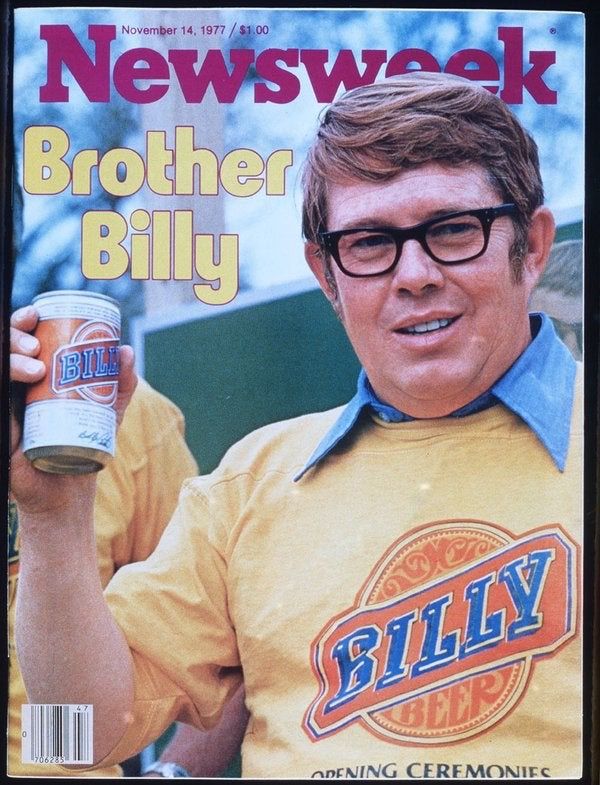
Billy Carter, the brother to former President Jimmy Carter, is shown with a can of Billy Beer that he endorsed and promoted in the late 1970s.

Eventually, my RC cans were dispatched to a grey, weathered barn that was starting to lean more than it was upright with a good part of its rusty tin roof curled back like the shavings from an appleโ€™s peel.

That summer I remained true, continuing to drink RC and adding to the collection, the cans climbing the slats around a feed crib that contained more rats than healthy ears of corn. But the rains came, as they do, and the bottom of the cans began to rust. And I picked up football in the fall and then basketball in the winter and spring. There would be girls and then a driverโ€™s license and the cans would topple and fall when the winter winds blew between the ever-widening planks of oak.

Eventually, the rust spread, covering the faces on the cans, and I could no longer see if I was looking at Freddie Patek or Pete Rose. One fall day, the cans were thrown into black plastic bags and tossed in the back corner of the corn crib, that darkest part down where the rats made their nest.

But the can of Billy Beer remained. For a while. 

More than 40 years later, the homeplace remains, as does my mom. Sheโ€™s like the maples she planted in that western Kentucky dirt. Still strong and rooted in place. The old barn has long been torn down, replaced by a shiny red, two-story building built by the Amish from down Crittenden way that is more guest living quarters than it is a work shed. 

The RC Cola cans are also long gone, dispatched not soon after my father left when most of his blue jeans and those country western shirts with the pearl snap-on buttons were taken from the closet and dumped in the backyard, doused with lighter fluid and a match was struck.

I donโ€™t know if I ever asked my mother if she took the cans to a recycling center or just simply put them in the burn barrel, their sides blackening, indistinct. Just another can in a smoldering mess of household garbage. Forgotten. 

Come to think of it, I donโ€™t know if weโ€™ve ever really discussed the divorce much.

The separation stung at first, but eventually as you get older and perhaps wiser and maybe forgiving, you learn to accept the betrayal and loneliness. Like the collector cans, the pronouncement of โ€œtill death do us part and forever and everโ€ was something that was just taking up space and needed to be thrown out. The connection gone.

Still, there are days, like today, when an overheard bit of conversation or a question about obsession takes me back to those cans of my childhood. Itโ€™s those memories that remain. Good and bad. 

Itโ€™s your mom going to the IGA, picking up a six-pack of RC Cola and there being two more Freddie Pateks in the bunch. You disappointed, but not saying anything as you pull the tab and drink the bland soda, hopeful for another day.

Itโ€™s spray painting a black square on the side of a brick wall. And bits of that square block still clinging to that sturdy brick, 40 years later.

Itโ€™s clinging to the past and hoping that what you hold will only become more precious as time goes on. But, more importantly, itโ€™s realizing when itโ€™s time to just take it out to the burn barrel, light a match and move on.

I do an Internet search and find that you can buy six of the RC Cola baseball collector cans for $20. Another seller is offering 53 of the used RC cans for $150.

A pristine can of Billy Beer, unopened, can be had for $21.ย 

But nobodyโ€™s buying.