A heart-shaped box of chocolates on Dyer hill

What could possibly become of a cold winter’s day, one impossibly large hill and a frozen box of chocolates?

When you’re 13 years old and you stare down Dyer hill, the snow still falling, your gloved hands wrapped around the sharp metal blades of your wooden sled, your heart is going to race.

Five slippery steps on the thin white powder, the ice-covered blacktop lurking below, then throwing the Western Auto Flexible Flyer out before you, the thump of your chest landing on the wood and then speeding head-first into a cold wall of winter.

Before you leap, you sneak a peek.

The girl with the freckles, the one who can throw a football farther than any boy and run just as fast, is watching. You begged your mother for the $5 bill and then read card after card until finding the Valentine that was just right – not too mushy, not too dorky – and the heart-shaped box of chocolates that you plan to leave in her mailbox when darkness descends.

Her blue eyes sparkle, the red scarf dotted with flakes of white to warm her lips, and your heart races and you run and you run and then you leap.

Editor’s Note: “A Heart-Shaped Box of Chocolates” stems from a writing prompt during the most recent Pen to Paper Live session hosted by the Charlotte Lit organization. You can register here. We were challenged to write a bit of flash fiction, no longer than six sentences, detailing a season and a moment during that season.

My love of grass

Fat Tuesday has me hungry for fine fescue

The lawn at Woodbend on a late April afternoon. Photo by Michael Banks

Most just shake their head and walk away. “No, no, no.”In fact, they are so adverse they’ll suddenly stop and turn, telling me their disdain is so great “I pay $50 every two weeks just so I don’t have to do it.”

They cannot comprehend my love of mowing my grass.

There’s something about sitting astride the bright green John Deere and hearing the motor catch when you turn the ignition. The slight shudder as the sharpened steel blade engages, in its wake the spring smell of fresh-cut fescue.

Maybe it’s about being in control. I follow the same path, a geometric pattern created some 15 summers past, only altered when the red buds grew tall and the azaleas wide and heavy with their showy whites and strawberry reds. My blade sweeps once and then again, shearing the blades to within 4 inches of the brown soil. Not 3 inches. Not 3 ½. But 4.

As with any love, there are tests. In the late summer heat, the sweat runs from your brow and you taste it on your lips. A cloud of red clay dust often blows, my Deere now brown, and the shards of crabgrass cling to my exposed ankles.

Yet, I sit and mow. Horizontal then diagonal. Always staying within the lines.

And on a Mardi Gras Tuesday, a day after thunder rumbled, lightning cracked and the rains fell, there is a ray of sun dancing upon my window frame. Beyond I see the clover and chickweed green and spreading, the fescue tall and waving in a cold wind.

I think of spring and my Deere.

And there is comfort in that.  

Editor’s Note: “My Love of Grass” stems from a writing prompt during the most recent Pen to Paper Live session hosted by the Charlotte Lit organization. You can register here. We were challenged to write of a love that is often neglected, a quieter love we all crave for comfort. We were told to focus on the concrete, grounded in actions and sensations, to bring the reader right there so they can feel the love first-hand.

Beanee Weenees in the parking lot

They’ve met for a year in the vacant parking lot. He’s always brought Beanee Weenees. She’s so tired of Beanee Weenees.

Editor’s Note: The following is an example of flash fiction stemming from a writing prompt during the most recent Pen to Paper Live session hosted by the Charlotte Lit organization. You can register here. We were given an example of flash fiction and encouraged to write from what inspires us.

The car door creaked and groaned as a 15-year-old Buick tends to do when he opened and closed the door. From the yellow plastic bag, he pulled forth a dented cup of Beanee Weanies. He smiled as if he was handing her a handful of sapphires. 

Sure, she likes the taste of hot dog chunks and gravy and beans. Her mistake was in telling him. Since that first time they agreed to meet in the back corner of the vacant Food Lion parking lot, it’s always been Beanee Weenees. For 30 minutes, they’ll sit in the Buick and hold hands. She’ll slurp and listen as he talks of tomorrow.

She’s so tired of Beanee Weenees. 

Today is exactly one year after their first lunch date. The box holding the ring holding the quarter carat feels heavy in his pocket. When, he wonders. He decides definitely after she’s had her Beanee Weenees.

Tripping with death high above the Barren River

Ride along on a trip to the “locks” with a pocketful of ‘shrooms.

The following is a short piece of fiction stemming from a writing prompt during the most recent Pen to Paper Live session hosted by the Charlotte Lit organization. You can register here. We writers were asked to recall a “near death” experience of our own––or imagine one for a fictional character––and describe the setting with as much sensory detail as possible

Tripping with death above the Barren River

The Barren River runs fast here, slicing through the forested green gorge, its metallic blue waters dotted with white outcroppings of rock, like a lost field of mushrooms dropped down among the foothills of western Kentucky.

College students come here where the river plunges 20 feet over the falls, the mist from where the waters splash off the limestone below creating cool wet clouds that rise and hover, leaving tiny wet droplets on your tanned skin. 

Seeking space from exams and empty wallets, 18-, 19- and 20-year-olds come to the Locks to sip cherry hooch mixed with pure grain alcohol and trip on shrooms. Those wise know to keep one in your group moderately sober as a trip to the Locks requires traversing a one-car-wide path that splits a sheer grey wall of granite and a dizzying drop of some 40 feet to the river below.

And it is here, 45 degrees vertical on that thin ribbon of road, where JD has decided to stop his hand-me-down hatchback. He needs to piss and it won’t wait until we reach level ground. 

I sit in the back seat alongside Adelphi and we tip our beer cans together. “Cheers, mate.” He giggles. I’m quite certain he gobbled most of the pocketful of shrooms JD carried and in his altered mind he’s anywhere but perched in a Pinto on the side of a cliff waiting on his driver, who is still visible through the front window, a yellow stream now snaking its way between JD’s legs, carving a path in the dry, dusty gravel. 

I glance out the open window and look down. It’s a straight shot, save for a few stubborn scraggly pines, to where the river runs clear below. I can smell the mist and hear the river hissing as it starts to run fast near the lip of the falls. I’ve never been one for heights. A boyhood trip up the St. Louis Arch left me light-headed and queasy and my back pressed against a carpeted wall, the people below a speck of tiny black dots moving hastily like worker ants serving a queen. 

Adelphi giggles some more and takes a long sip from his beer.

“Fuck it,” he says, leaning forward and over the front seat. As if in slow motion, I watch Adelphi as he shifts the gear stick into neutral and, giggling again, flops back, landing partly atop me, his beer spilling onto my jeans. There’s the smell of warm hops and a sudden lurch in my stomach as I feel gravity grab hold of the Pinto and we start to slowly move downhill.

Hearing the crunch of tires on gravel, JD has turned around, his hand still around his pecker and a look of curiosity upon his face as he tries to ponder how his one piece of tangible party has slipped into gear and is steadily moving backwards toward where the road bends, a literal dropping-off point.

“We’re moving, man, we’re moving!” Adelphi shouts out, reaching up to the top of the brown felt roof, his hands rhythmically smacking again and again, seeking out whatever unicorns or demons are filling his head space.

“We’re moving, man, we’re moving.”

Adelphi

I feel my own fingers digging in between the cushions, thinking a seat belt strapped around my waist is going to do me some good when that Pinto plummets backward off the cliff, smacks three pines on its way down and ends up, roof down, wedged between two big boulders, water streaming in and me stuck in place with my seat belt. Instead, my hands pull out a months-old peppermint and three years’ worth of brown, sticky lint.

My eyes remain on the front window, focused on JD, who has now taken on the form of a hermit crab, his legs askew, jeans still unzipped, pecker flopping, as his pudgy arms try to keep pace with his even fatter legs. He runs for his Pinto, its back bumper bouncing us off the wall of granite like the shiny silver ball ricocheting off the bumpers on the pinball machine I used to pump quarters into on Sunday mornings between Sunday school and worship service. Seems like years ago.

Game literally over, I think, surprising myself in the clarity and calmness of how one accepts one’s demise. My hands grip the headrest in front of me and I push my spine farther into the back seat cushion, readying for the free flight, bracing for the bone-jarring impact. 

“It’s beautiful,” Adelphi says, linking his arm around my bicep, pulling himself close. He leans his head back and lets loose with some Skynyrd in the sweetest harmony I’ve heard. And there, in that moment, I realize I’ve never known Adelphi to sing. 

“If I leave here tomorrow

Would you still remember me”

I’m fine with dying, I say to myself, and close my eyes. If it must be like this, then it’s gonna be.

“For I must be traveling on, now

‘Cause there’s too many places I’ve got to see”

I savor the air that enters my mouth and fills my lungs, counting each breath. One… two…. I can taste the river on my tongue now, the wetness and cold awaiting. I hear the spring breeze whistling through the pines and I think of dead doves.

One breath. Exhale. Two breaths. Exhale.

“My father, who art in heaven,” I mumble, my mind in a jumble, trying to remember the words.

Adelphi now in full chorus.

“Cause I’m as free as a bird now

And this bird you cannot chaaaannnngggggeeeeeee”

The car lurches and our heads snap back and then forward, my forehead smacking the head rest, my fingers white, clenched in the foam.

I later come to find out that JD, that sweet, plump, slow-moving snail, had somehow managed to catch up with the Pinto and then wedged himself inside the open door and thrown his body into the driver’s side floorboard, his hands slamming down on the brake pedal, the Pinto’s back bumper hanging off the edge.

For a few moments we sit there in silence. The river still hisses below, almost like it’s angry, mad that it’s missed out on its allotment of drunk, foolhardy, teenagers. The spring breeze still blows and I feel it enter the open window, cool on my face that’s wet with sweat.

Adelphi breaks the silence. “Glorious day, dude.”

JD sits upright, closes the door and turns the ignition. The Pinto finally catches, slips into gear and then climbs, in its wake just dust and the river waters that run through the rocks and cascade down.

The last toast

A man chooses to stop drinking. What gets left behind, what is lost?

The following is a short piece of fiction stemming from a writing prompt during the most recent Pen to Paper Live session hosted by the Charlotte Lit organization. You can register here. On the eve of the presidential inauguration, the prompt was to examine what ends when something new begins? What gets lost, what gets left behind?

The Last Toast

Today is the day I stop drinking.

Seven words skewered in pencil on the back of an overdue electric bill from the City of Decatur.

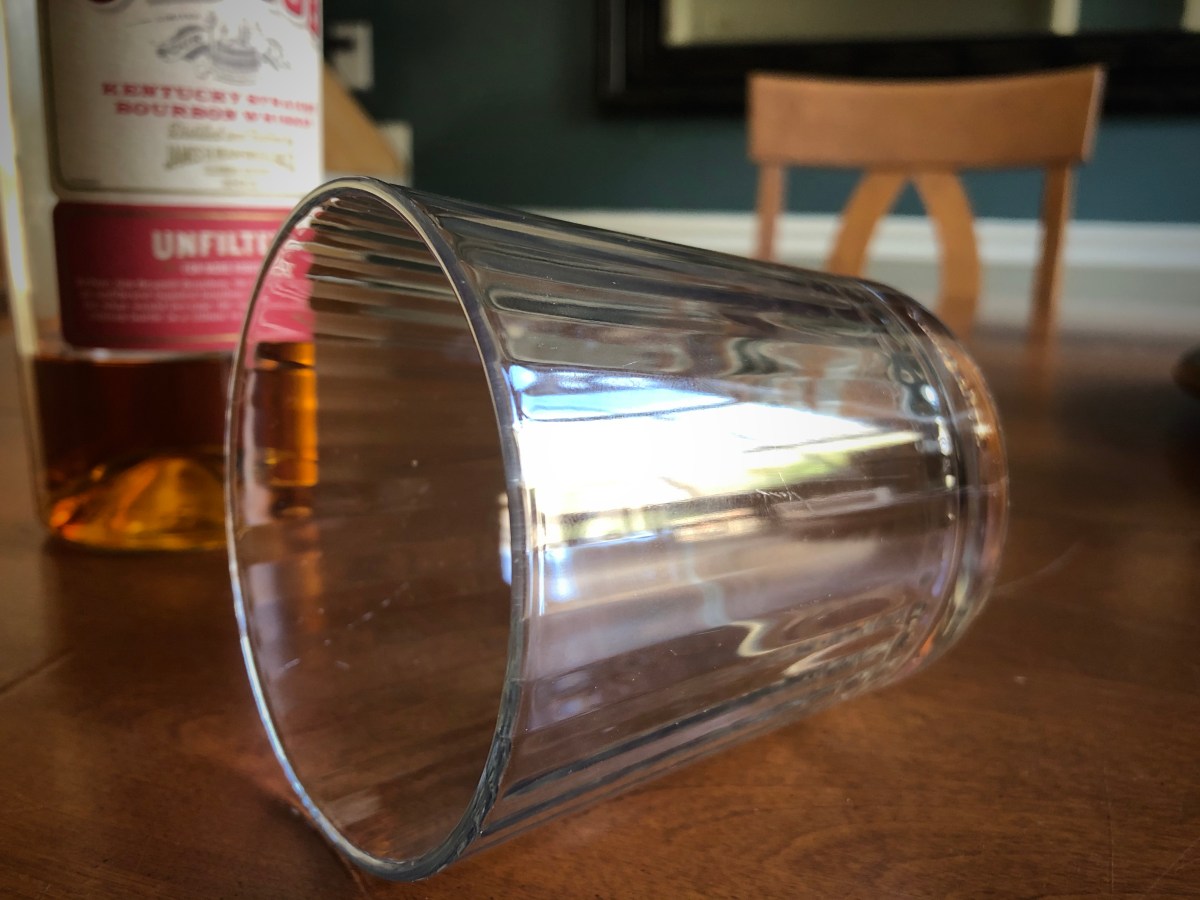
The words a promise I’d made to myself some six hours earlier. Now the empty fifth of Kentucky Tavern on its side, a small pool of the brown elixir lingering in the glass on the nightstand, a remnant of the night before.

There’s a momentary urge to bring the cool glass to my lips to feel the burn of the whiskey as it hits my tongue, that sensory overload only topped by the feeling of warmth that spreads through my torso.

I’ll miss it. 

We had our falling outs, particularly that DWI three years back and those hungover mornings where I lay curled in bed instead of cutting wood. And, of course, there’s Rebecca. She said I loved the drink more than her.

For a while now, it’s been just me and the whiskey. And, for a while now, that’s been just fine.

Oh, we had our fun. 

That first sip when I was 14, the bottle passed from my daddy as we sat on the tailgate of the pickup truck waiting for the doves to rise from the brush. My welcome to manhood moment.

That late summer night down in the back woods of the Chattahoochee, three dates in with Rebecca, sharing the pint in the back seat of my Pinto, that hot spice sticking to my tongue, my lips numb.

Plenty of graduation celebrations, keg parties, afterwork socials, snips on lunch breaks, morning pick-me-ups, afternoon get-me-throughs.

We became good friends. Maybe too good of friends.

Comes a time when a man’s got to do what he thinks is best for him. And for me, that’s leaving you, whiskey.

Don’t you come knocking again on my door.

Please.