Everybody talkin’. Preacher man preachin’.
Let’s talk ekphrasis, a written response to a work of art, and my take on Romare Bearden’s “Carolina Shout.”
Words by Michael Banks in response to artist Romare Bearden’s collage titled “Carolina Shout.”
Everybody talkin’. Preacher man preachin’.

Everybody's hands out. Ain’t nobody givin'.

Falling in the water. Red moon a risin’.

Bringing back a dead man. Ain’t that their mission?
Gotta get right. Gotta get salvation.

Ain’t nobody know my sticky situation.

Feet in the mud. Brotherhood of Nation.

Everybody hands up. Meet my creation.
Tuesday mornings, I try to set aside an hour to jumpstart that creative part of my brain. I find it getting harder and harder to do so as the years creep by. But one thing I’ve discovered that helps immensely is Pen to Paper Live.
These weekly one-hour sessions conducted by the founders and staff of the Charlotte Lit organization are held over Zoom. Often more than 20 creators gather and write after receiving a “prompt” by the instructor. Some of my published works have gotten their start at Pen to Paper and I’m always inspired and comforted by the talented writers who gather there weekly.
The words I’ve written above come from the Tuesday, Oct. 4, 2022, session led by Kathie Collins, one of the founders of Charlotte Lit. The prompt was ekphrasis, which Kathie described as “a written response to a work of art.” I’ve tried a bit of ekphrastic writing before, mainly with Van Gogh’s “Wheatfield of Crows,” and it surprises me the words that come to me from another’s work of art.
On Tuesday, as an example, Kathie pointed to writer Sharan Strange’s poem titled “Train Whistle” that’s taken from artist Romare Bearden’s collage “Mecklenburg County, Daybreak Express.”
Born in Charlotte, NC, in 1911, Romare Bearden, by the time of his death in 1988, had achieved a stature known by few artists during their lifetimes. He is considered America’s greatest collagist and his works are in the permanent collections of most every major American museum.
This entire month, Charlotte Lit is celebrating Bearden and his legacy. Through a series of events titled “Artists Reckoning With Home: Celebrating Romare Bearden,” the arts organization hopes these events provide opportunities to learn about Charlotte’s past and re-imagine its future.
One of the featured events will be an ekphrastic workshop titled “Writing With Bearden.” The workshop, led by Charlotte Lit co-founders Kathie Collins and Paul Reali, will be held Sunday, Oct. 16 from 2 to 3 p.m. at the Mint Museum Uptown. The event is free, but registration is required.
Like what you see? Please share this via the following methods:
John Glenn Creel is a family doctor that runs his own practice, Walterboro Adult & Pediatric Medicine, and is chief of the Edisto Natchez-Kusso Tribe of SC and pastor of his own church, Little Rock Holiness Church.
“I try to use my time wisely. When I’m sitting, I just can’t sit.”
Chief of SC’s Edisto Natchez-Kusso Tribe also serves as family doctor and pastor
John Glenn Creel is the owner of Walterboro Adult and Pediatric Medicine, where he’s a family medicine physician. He’s also chief of the Edisto Natchez-Kusso Tribe, which numbers 756 members, and pastor of Little Rock Holiness Church in Cottageville, S.C. Photo by Milton Morris.
What’s the best way to address a man whose been pastor at his hometown church for the past 25 years, is a longtime family physician and chief of one of the state’s largest Native American tribes?
“Servant,” says John Glenn Creel, who has always called Colleton County home. He and his wife, Charlene, still live in a house next to his parents, where a midwife delivered him on Halloween as “Andy Griffith” played on the TV.
As a child, he struggled in math and reading and he even repeated the fourth grade. His goal of becoming a doctor seemed unattainable.
“I just thought it wouldn’t be possible being a minority and a minority in a very rural community,” he says. “We had limited income, limited resources. We’re Native Americans, but we’re not federally recognized. That was a big obstacle.”
As chief of the Edisto Natchez-Kusso Tribe, which numbers 756 members, it’s his goal to achieve that federal recognition, clearing the way to access for federal grants. That money can be used to expand the hours and services provided at the non-profit Four Holes Edisto-Natchez-Kusso Indian Free Clinic he operates, as well as build a new museum and help teach “future generations who we are and to be proud of who we are.”
That’s important, says the father of three.
“I’ve done the best to try and balance things and keep the focus on the family. That’s how it was with my parents. We were always together. Family’s important. So is being in a small community. It’s not the just the family and parents that raise the child, it’s the village or the community. And our communities have always been close-knit.”
Being a self-described “master delegator” helps him manage a full schedule. His mind is in constant motion, even when he gets away for one of his favorite activities — hunting.
“I’m probably the only one that will sit in a deer stand and do continuing medical education questions,” Creel says. “I try to use my time wisely. When I’m sitting, I just can’t sit. I can prepare sermons when I sit in the stand.”
Faith is a constant companion during a life that hasn’t always been easy. The first of their three children, John Charles, was born with spina bifida. Doctors didn’t believe he’d live past the age of 2. “JC” is now 37 and ministers alongside his father. Charlene was diagnosed with stage four colon cancer in 2020.
“Part of this life for Christ is to carry that cross,” Creel says. “I don’t mind carrying the cross, because it’s wonderful. Sometimes you’ll begin to feel the weight of that cross. It’s then that I’ll say, ‘Lord, I need your help.’ And then He gives grace. It’s the touch of his hand that makes the difference.”
Getting to know Glenn Creel
John Glenn Creel
Age: 54 (birthdate 10-30-1967)
Hometown: Cottageville, S.C.
Claim to fame: In 2020, he was elected chief of the Edisto Natchez-Kusso Native American Tribe of South Carolina and, for the past 25 years, he’s served as pastor of Little Rock Holiness Church in Cottageville.
Day job: He’s owner of Walterboro Adult and Pediatric Medicine, where he’s a family medicine physician and mentors students as an associate professor of family medicine for his alma mater, the Medical University of South Carolina in Charleston.
Co-Op Affiliation: Creel is a member of the Coastal Electric Co-Op in Walterboro, S.C.
Editor’s Note: A version of this SC Stories profile was featured in the October 2021 issue of South Carolina Living, a magazine that is distributed 11 times a year to more than 1 million South Carolinians by The Electric Cooperatives of South Carolina.
Like what you see? Please share this via the following methods:
Lin-Manuel Miranda writes like he’s running out of time and I’m staring at a blank page.
There’s a blank page before me and, damn it, if I don’t blame Lin-Manuel Miranda.
“It’s like the drip, drip, drip that’ll never stop.”
“Encanto.” “Hamilton.” Something to take your mind off the writing, she said. I watch and I hear the words of Lin-Manuel and I stew and the next morn comes and the day is still gray.
“Rise up.”
My mind doesn’t stop now. It’s an endless loop of Lin-Manuel and his rhythm.
“Rise up.”
Again, Lin-Manuel, get out of my head.
“Rise up.”
The blank page awaits. I try morning, then noon, then night. But the words still don’t come.
“Oh, no. We don’t talk about Bruno.”
Rhyme after rhyme fills my head. But my words do not come. Not the words that Lin-Manuel Miranda writes. So creative. So talented. So damn good.
Yet, all I have is the blank page and Lin-Manuel in my head.
“I’m willing to wait for it. Wait for it. Wait for it. Wait for it. Wait for it.”
Lin-Manuel Miranda is shown in Columbia in 2018 in this photo taken from his Twitter page @Lin_Manuel. Miranda is an American actor, singer-songwriter, playwright, and film director. He is known for creating the Broadway musicals ‘In the Heights’ and ‘Hamilton,’ and the soundtrack of Disney’s ‘Encanto.’
NOTE: The above work came from a writing prompt presented during a recent Pen to Paper Live session hosted by the Charlotte Lit organization. You can register here. In the session, presenter Kathie Collins offered a writing prompt taken from a recent workshop led by poet Jessica Jacobs.We were challenged to try some layered writing in which we’d use some metaphors, physical objects, paintings, etc. to connect an experience we were feeling.
Like what you see? Please share this via the following methods:
The rain falls here down near where the South Fork and Catawba meet.
The branches of the tea olive outside my window hang heavy with water, lime green offshoots reach up, seeking sunlight, but instead it’s a cloud-filled sky. Tiny yellow clusters of bloom emit the sweet scent, but my window stays closed and I fear more rain.
I think of my great aunt Catherine, she gone nearly 15 years now, and how she’d tug my ear and say, “Michael B. You’re gonna do great things.”
But this morning, my mind remains muddied of the dream that lingers from the night before – me going from room to room, opening doors, only to find four blank walls and empty spaces. The only sound being that of the click of the latch and slam of the door. A constant opening and closing. Click, slam. Click, slam.
I sip the cold water from the glass and wait for the coolness to make its way down my throat and spread across my chest. I hope it brings energy. A spark to beat back my malaise. The bed, the warm covers, they beckon.
Gloom, gloom, gloom.
The Rolling Stones sing of “Wild Horses” and how “faith has been broken, tears must be cried, let’s do some living, after we die.”
I’ve done some living and never really thought of others. Things I should have said, but didn’t. Thought my silence an easy salve, not realizing the pain left behind.
It is still Tuesday morn here and the rain still falls.
Each day another red X on the calendar and another day closer to when breath will come no more.
Until then, these words will be written and songs will be sung. Her smile and laugh and love as constant as the reappearing sun.
NOTE: The above work came from a writing prompt presented during a recent Pen to Paper Live session hosted by the Charlotte Lit organization. You can register here. In the session, presenter Kathie Collins offered a writing prompt taken from a recent workshop led by poet Ada Limon.
Some of the sights and sounds of a fantasy football draft.
It’s an early Saturday in Vegas, the sun climbing above the Valley of Fire only a few hours earlier, and a pack of Pakistanis behind me are chittering like hyenas surrounding a fresh kill.
“Adreeeen Peterson, Aaaadddreeen Peterson, Ayyydreeeen Peterson,” they chant, clapping and hopping from one foot to another, their target one of their own – he apparently shell-shocked, face dazed, finger still hovering over his laptop.
Moments earlier, he’d kicked off their fantasy football draft by making the first overall selection. Only problem was that he’d selected the wrong Adrian Peterson. Instead of drafting fantasy stud Adrian Peterson, the future Hall of Famer and bellcow for fantasy championship squads, our Pakistani had instead selected the Chicago Bears’ Adrian Peterson, he of few yards and even fewer championships.
And still they clap and chant. “Ayyydreeen Peterson, Ayyydreeen Peterson, Aydreen Peterson.”
The wayward Pakistani sinks his head to his table, accepting his fate and knowing his season is over before it starts
I turn back to my table and stare across at H-Diddy. He’s wearing his Bears jersey, arms folded across his chest, and he’s alternating between taking puffs of a Monte Cristal he’s kept stashed away from his wife over the past nine months, while popping green, yellow and orange M&Ms
“Things happen,” Diddy says, his facial features temporarily clouded in puff of Cristal. The smoke rises and he smiles. “Vegas, baby.”
Like what you see? Please share this via the following methods:
Best writing advice? Well, there is a Hemingway quote that hangs on my wall: “Write drunk. Edit sober.”
I was recently asked to be a featured member of the Charlotte Writers’ Club. The feature, dubbed Meet A Member, runs in each monthly newsletter and is a great way to learn more about the fellow club members.
I’ve been a member of the Charlotte Writers’ Club for nearly two years now and have found it to be a great resource as I venture into the world of fiction writing and freelance work.
One of my favorite benefits of being a club member are the monthly programs by published authors taking on such topics as “Maintaining Suspense in Your Writing” and “Getting to Know Your Character.” The club holds several writing contests throughout the year and rewards the top submissions.
There are also opportunities to present your work during Open Mic Nights, as well as a Virtual Writing Salon. There is the supportive community of fellow writers tackling many of the same issues, as well as chances to share feedback as part of several critique groups.
All in all, I’ve found a very worthwhile organization and one that I’m happy to be a member of.
What follows are my responses to the questions asked each month of the featured club member.
Meet a Member for July 2021
Michael Banks
Bio: A product of the western Kentucky coal and corn fields, I’ve spent most of my life documenting achievements and failings while working as a journalist at newspapers in Kentucky, Mississippi and North Carolina. I keep rowdy fans in check at Panthers games, write random features for magazines and enjoy the occasional sip of bourbon beneath my redbuds. All while pondering the first draft of my first novel.
When and Where Do I Write? I’ve found the Open Studio at Charlotte Lit to be a perfect place to get away and get my words down — morning, noon and night.
Favorite writing tool? I wish I could say I bang out my scenes via Hemingway’s Royal Quiet Deluxe typewriter. Instead, it’s the soft pitter-patter of my MacBook Pro that brings comfort.
A favorite writing resource? Notes taken from Charlotte Lit classes and CWC presentations are a great help, but I find that when I’m stuck I go in search of some of my favorite authors. Ron Rash and Jennifer Egan have helped get me back on track lately.
Best Writing advice you’ve received and actually taken? On my office wall hangs a supposed Hemingway quote: “Write drunk. Edit sober.” Claire Fullerton says, “For a writer, there is no there to get to, there is only the fulfilling, soul-driven act.” And that goes hand-in-hand with what I heard fellow CWC member Landis Wade say once: “Find joy in the process.” All good advice, I’d say.
One thing I would like help with? Now that the first draft is done, what’s next? How do we embrace revision? How do we query? The benefits of self-publishing? I’ve got quite the laundry list.
Membership in the Charlotte Writers Club entitles one to participate in workshops, critique groups, contests, and guest speaker programs. The cost is a modest $35 per year for individuals and $20 for students.
The organization welcomes all writers in all genres and forms to join our Charlotte-area literary community. A membership in the Charlotte Writers’ Club helps support writers, readers, and literacy at a critical time in our nation’s and our city’s history.
To join or renew a membership, click this Membership Link and follow the instructions.
Like what you see? Please share this via the following methods:
It was the summer of 1978 and I discovered RC Cola and baseball. My daddy? Well, he found Billy Beer.
In the summer of 1978, I discovered RC Cola and baseball.
I guess the soda that was a cheap knock-off of Coca-Cola had always been around, as was baseball, but that summer I consumed as much of both as humanly possible.
The reason? The collector cans that featured the RC logo and its slogan “Me and My RC” on one side and a photo of a Major League Baseball player on the other with his signature, stats and other pertinent information, such as was he right-handed or left-handed.
The collecting became an obsession and the stack of royal blue 12-ounce cans soon filled a wall of my bedroom. While I was always hopeful of an All-Star, such as Pete Rose or Reggie Jackson, it was multiple cans of little-known light-hitters like Freddie Patek and Bobby Grich that made up my shrine.
These ballplayers were the ones I heard Jack Buck talk about at night and on Sunday afternoons, his voice stretching from the St. Louis Arch out across the corn fields of Southern Illinois and the cliffs of the Shawnee National Forest, across the Ohio River and into our little pocket of western Kentucky.
We lived “out in the country” as they said back then and my momma said it was too far to drive into town for Little League baseball. So, one day, I took a can of black spray paint and drew out a square strike zone on the side of our new brick home. I picked up a rubber ball and stood 12 feet away and threw as hard as I could, over and over, aiming for perfection. My daddy came home, saw what I did, spanked me good and gave me a can of turpentine and told me to scrub. And I did, until my fingers ached, but that black box remained, now part of our home.
And, inside those brick walls, the monument of tin cans grew larger and larger as I drank more and more RC. And, as you can surmise, an 11-year-old boy hopped up on caffeinated soda is going be clumsy and careless and the temple would often come clanging down, oftentimes at night when I’d stumble making my way to the bathroom.
Maybe collecting the cans was a gene thing, like a widow’s peak hairline, passed down from generation to generation.
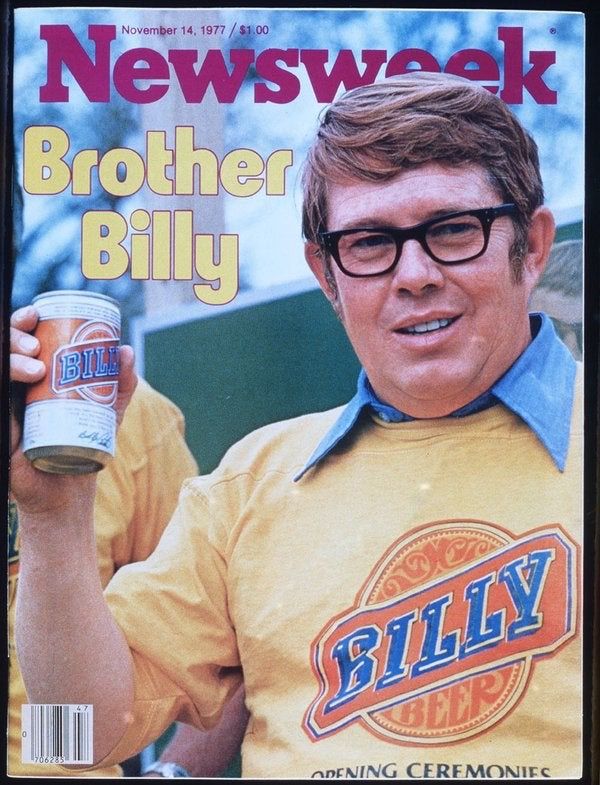
My dad cherished a can of unopened Billy Beer, a beverage known more for being endorsed by the beer-guzzling brother of then President Carter than for its taste. And he proudly displayed that single can of Billy Beer on our living room mantle next to the family Bible handed down by the teetotaling Robinsons on my mother’s side. I’m sure he saw fortune in his future and a day when that can of Billy Beer would be worth thousands of dollars.
But maybe it was more than that.
Billy Carter, the brother to former President Jimmy Carter, is shown with a can of Billy Beer that he endorsed and promoted in the late 1970s.
Eventually, my RC cans were dispatched to a grey, weathered barn that was starting to lean more than it was upright with a good part of its rusty tin roof curled back like the shavings from an apple’s peel.
That summer I remained true, continuing to drink RC and adding to the collection, the cans climbing the slats around a feed crib that contained more rats than healthy ears of corn. But the rains came, as they do, and the bottom of the cans began to rust. And I picked up football in the fall and then basketball in the winter and spring. There would be girls and then a driver’s license and the cans would topple and fall when the winter winds blew between the ever-widening planks of oak.
Eventually, the rust spread, covering the faces on the cans, and I could no longer see if I was looking at Freddie Patek or Pete Rose. One fall day, the cans were thrown into black plastic bags and tossed in the back corner of the corn crib, that darkest part down where the rats made their nest.
But the can of Billy Beer remained. For a while.
More than 40 years later, the homeplace remains, as does my mom. She’s like the maples she planted in that western Kentucky dirt. Still strong and rooted in place. The old barn has long been torn down, replaced by a shiny red, two-story building built by the Amish from down Crittenden way that is more guest living quarters than it is a work shed.
The RC Cola cans are also long gone, dispatched not soon after my father left when most of his blue jeans and those country western shirts with the pearl snap-on buttons were taken from the closet and dumped in the backyard, doused with lighter fluid and a match was struck.
I don’t know if I ever asked my mother if she took the cans to a recycling center or just simply put them in the burn barrel, their sides blackening, indistinct. Just another can in a smoldering mess of household garbage. Forgotten.
Come to think of it, I don’t know if we’ve ever really discussed the divorce much.
The separation stung at first, but eventually as you get older and perhaps wiser and maybe forgiving, you learn to accept the betrayal and loneliness. Like the collector cans, the pronouncement of “till death do us part and forever and ever” was something that was just taking up space and needed to be thrown out. The connection gone.
Still, there are days, like today, when an overheard bit of conversation or a question about obsession takes me back to those cans of my childhood. It’s those memories that remain. Good and bad.
It’s your mom going to the IGA, picking up a six-pack of RC Cola and there being two more Freddie Pateks in the bunch. You disappointed, but not saying anything as you pull the tab and drink the bland soda, hopeful for another day.
It’s spray painting a black square on the side of a brick wall. And bits of that square block still clinging to that sturdy brick, 40 years later.
It’s clinging to the past and hoping that what you hold will only become more precious as time goes on. But, more importantly, it’s realizing when it’s time to just take it out to the burn barrel, light a match and move on.
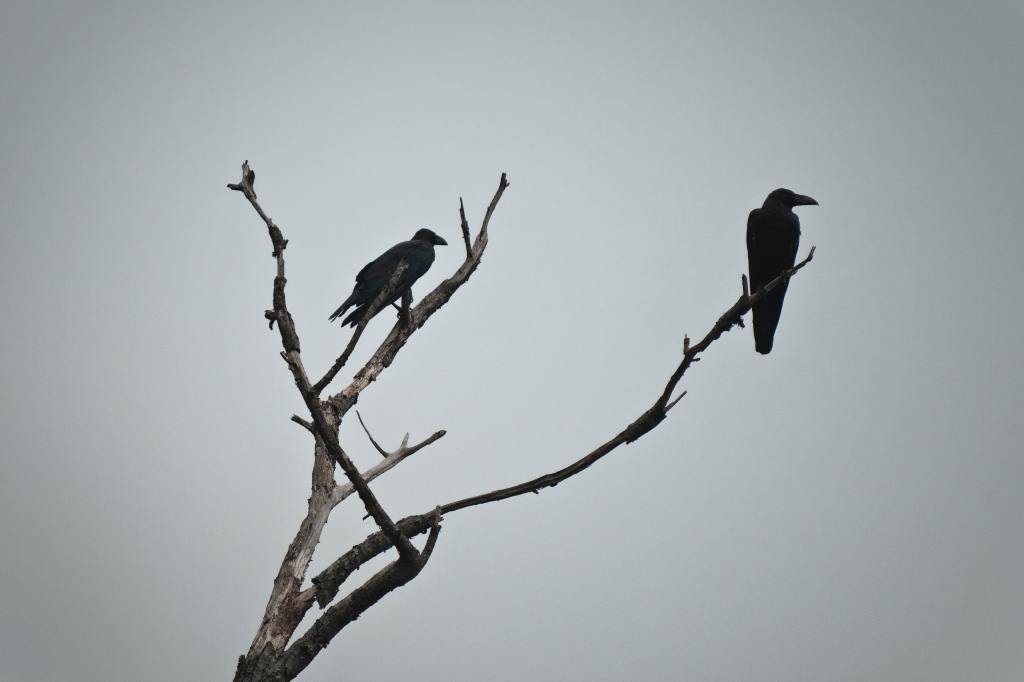
I hear the incessant “caw, caw, caw” and I want to place my hands over my ears and hum the words to a happy song. But nothing comes to my lips.
The crow is black. The crow is foreboding.
Is the crow death?
In the river bottoms, the crows come in packs, swooping low over the harvested fields, the broken stalks of corn like the limbs of war dead, half-in, half-out of the grey, boot-sucking muck.
A murder of crows is what they call that pack of black that fills the fading light of late afternoon.
“Fitting,” I mutter to myself, raising the collar of my worn pea coat to my neck, a shield against the harsh December wind that comes from the north.
I, too, am in my final season and I believe the crow knows.
I skirt the field and climb the hill and they fill the branches of the barren oak that rises up and over the farmhouse. The roof has started to sag from the weight of rain and all these years. I know that I’ll not repair it.
Inside, where my wife once stood at the stove, stirring the pot of soup, and the brown-headed girl, she being 10 then, came to me with open arms and words of “daddy, daddy, daddy,” it is now quiet. On the wooden table, there is an opened bag of bread, a slice of white lies to the side left to grow stale. Mold just a few days away.
My breath catches and I feel a tightening in my chest. I retreat back to the cold wind that whips around the porch and I stumble down the three wooden steps. I stuff my hands in my pockets and hunch my shoulders.
I don’t look up. There’s no need. I know the crow is near.
NOTE:The above work of fiction came from a writing prompt presented during a recent Pen to Paper Live session hosted by the Charlotte Lit organization. You can register here. In the session, presenter Kathie Collins challenged us to respond to the Van Gogh painting “Wheatfield With Crows” and write what moved us.An interesting note is that the painting is believed to be the last work of the celebrated painter.
Like what you see? Please share this via the following methods:
The free weekly sessions offer a mini-lesson and and present a writing prompt. Though I have been a member of Charlotte Lit and its Author’s Lab for the past year, this was the first opportunity I had to participate in one of the writing-in-community sessions, which are usually held in person but were moved online with the pandemic and social distancing restrictions. This one was attended by 14 other writers.
I thoroughly enjoyed the hour-long meet-up and would highly recommend it for those creative sorts who are currently uninspired or stuck. Preregistration is required. For this non-coffee-drinking guy who can sleepwalk through the hours before noon, Pen to Paper Live! gave me a spark and led to me writing this blog and continuing work on my novel.
This week’s session was on Cento. Kathie Collins, executive director and one of the founders of Charlotte Lit, led Tuesday’s session and came up with the writing prompt from a recent article in the New York Times. You can read the article to learn more, but basically Cento is a sort of “collage poem” crafted from lines, words, phrases from other sources and then patching together those lines to create a poem.
It’s a way of allowing you to express some subconscious needs through someone else’s work, Collins said. “Consider it another tool for your toolbox,” she said.
I am far from a poet, as the following selection will absolutely prove, but I did find it a fun, creative exercise. For my assignment, I chose to pull from the writings of author Hank Burdine and his story collection “Dust in the Road: Recollections of a Delta Boy.” The story “The ‘Britchesless’ Bachelor” is one of my favorites, especially hearing Hank read it in person with his Delta drawl and his deep baritone acquired via healthy amounts of good whiskey.
Below is my first attempt at Cento. Let’s call it:
Jelly and Whiskey in the Delta
White-coated valets and 15 blue-haired little ladies
Gather for sundry debutante parties in Beulah in the Delta
Me, a member of the Bachelor’s Club, a pool for the Delta Debs
Made haste to Dossett Plantation in my black two-door Pontiac Grand Prix
I arrived in a hand-me-down tuxedo with cummerbund
Yet, about to pass out because my britches were too tight
My date, Blanche Shackleford, fled to the slough unencumbered
As the Budweiser had filled her holding tank, quite a site.
Meanwhile, my unhitched pants fell to my knees
And I’d forgotten to put my car in park
Blanche emerged from the slough and the trees,
And so, Blanche gave chase, shaking and boogying
So fierce, her left bosom shimmied out of her dress
And there it remained, quivering like jelly.
“Blanche, my Gawd” the little ladies shouted
Upon which, she tucked it right back into the top of her gown
And I, on a quest to drink good whiskey
found Mr. Dixon Dossett where we told tall tales in his gunroom until dawn.
Compiled from “The Britchesless Batchelor.” A story from “Dust in the Road: Recollections of a Delta Boy” by Mississippi author Hank Burdine.
Like what you see? Please share this via the following methods:









 Michael Banks 360